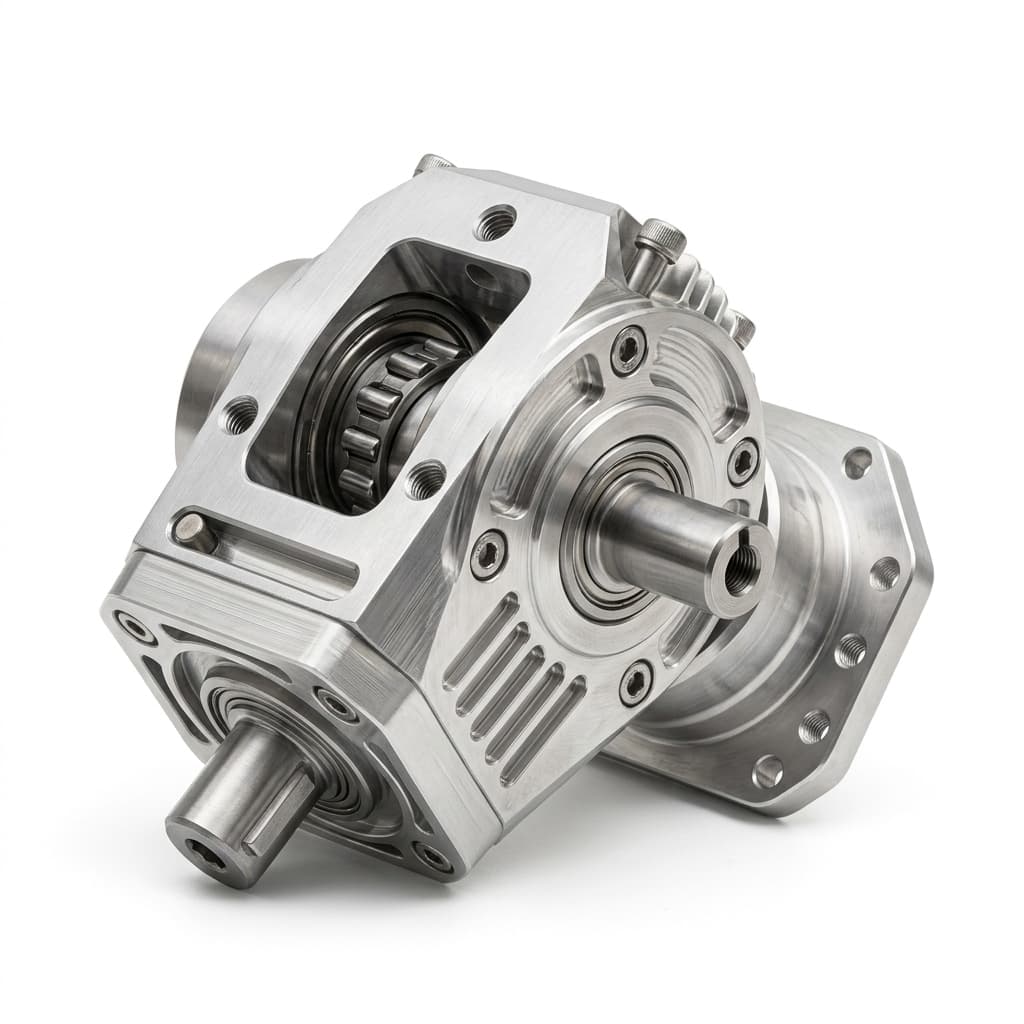
Stress Relief for CNC Aluminum Parts: Why Micron-Level Tolerances Fail After 48 Hours
Practical stress relief process guide for 2017 aluminum CNC parts covering residual stress sources, furnace parameters, soak times, and cooling methods to prevent post-machining deformation in precision programs.
Your part measured dead-on at final inspection. Two days later, on the assembly bench, it is warped. The buyer calls. The program slips.
This failure mode is not rare. It is one of the most common silent killers in precision CNC aluminum machining — especially for semiconductor equipment, optical instruments, industrial mold bases, and coordinate measuring devices that demand micron-level dimensional stability over time.
If you are a hardware engineer or procurement lead buying precision aluminum CNC parts, this guide gives you the specific process parameters, decision tables, and supplier qualification criteria you need to prevent post-machining deformation.
Related capability pages:
- Rapid CNC Prototyping
- Complex CNC Prototype Manufacturing
- Custom CNC Parts Examples
- Motion Hardware Hub
- Quality / Validation
- Robotics Actuator CNC Proof
For motion-hardware buyers, stress-relief planning should travel with the RFQ's CTQ list, not sit in a separate process note. Bearing bores, encoder datums, rotor/stator carrier faces, and robot-joint interfaces all need the inspection method and acceptance timing defined before sample release.
The real problem: residual stress hiding inside your finished part
When a CNC part passes dimensional inspection immediately after machining, it only means the part is dimensionally correct under the current internal stress equilibrium. Remove one constraint — unclamp the part, let it sit on a shelf, change the ambient temperature — and the stress field redistributes. The part moves. Microns disappear.
This is not a machining error. It is a stress management failure in the process chain.
To understand why, you need to know where residual stress comes from and how much each source contributes.
Six sources of residual stress in CNC aluminum parts
Most engineers only think about cutting stress. That is a critical underestimation. In a typical aluminum CNC part, residual stress accumulates from at least six independent sources, and they all superimpose inside the finished part.
Six Sources of Residual Stress in CNC Aluminum Parts
Relative stress contribution by source — all sources superimpose inside the finished part
Source 1: Cutting stress (highest contributor)
High-speed milling generates extreme localized heat and plastic deformation in the surface layer. The cutting zone temperature can exceed 300°C momentarily, creating steep thermal gradients that lock compressive and tensile stress into the part skin.
| Parameter | Effect on residual stress |
|---|---|
| Spindle speed | Higher RPM → more heat → more surface stress |
| Feed rate | Aggressive feeds increase plastic deformation depth |
| Depth of cut | Deep cuts remove more material but leave higher stress |
| Tool wear | Worn tools generate more friction heat and irregular stress |
| Coolant effectiveness | Poor coolant coverage allows stress to penetrate deeper |
Key insight: Every machined surface carries cutting stress. On a complex 5-axis part with 20+ machined features, cutting stress accumulates from every toolpath, in every direction.
Source 2: Clamping stress
Workholding force elastically deforms the blank during machining. The part shape during cutting is not the free-state shape. Upon unclamping, the part springs back to a new equilibrium that may differ from the inspected dimensions.
Common clamping stress risk factors:
- Thin-wall sections clamped with jaw vises
- Plate-like parts held with vacuum chucks at insufficient pressure
- Asymmetric clamping that creates bending moments
- Over-torqued fixture bolts on compliant geometries
Source 3: Raw material stress
Aluminum billet and extrusion stock arrive from the mill with embedded internal stress from:
- Casting solidification — differential cooling rates through the cross-section
- Rolling or extrusion — plastic flow creates directional stress patterns
- Straightening operations — cold mechanical correction adds bending stress
Even before your first cut, the blank already carries a non-uniform stress field. Removing material during machining uncovers and redistributes this pre-existing stress.
Source 4: Heat treatment stress
Quenching is the single largest source of process-induced stress in heat-treatable aluminum alloys. When a T6 temper billet is water-quenched from solution temperature (~500°C), the surface cools rapidly while the core remains hot. This creates:
| Zone | Stress state after quench |
|---|---|
| Surface | Compressive (cooled and contracted first) |
| Core | Tensile (contracted against already-rigid surface) |
The magnitude can reach 50-100 MPa in thick cross-sections — enough to cause measurable distortion when machining removes the compressive surface layer.
Source 5: Welding stress
Any welded joint creates a localized heat-affected zone (HAZ) with steep residual stress gradients. For parts with welded features before machining, this stress is pre-embedded and difficult to predict.
Source 6: Thermal gradient stress
Uneven cooling during any process step — including post-machining cooldown — introduces differential contraction stress. Even ambient temperature variation between a 25°C air-conditioned inspection room and a 35°C warehouse can contribute to slow stress redistribution in sensitive parts.
Why 2017 aluminum is especially dangerous
Not all aluminum alloys respond the same way to residual stress. Different alloys have fundamentally different stress sensitivity profiles:
| Alloy | UTS (MPa) | Yield (MPa) | Stress sensitivity | Stress relief risk |
|---|---|---|---|---|
| 2017-T4 | 427 | 275 | Very High | Critical — high stored elastic energy, Cu-rich matrix resists relaxation |
| 2024-T351 | 470 | 325 | Very High | Critical — aerospace standard, pre-stretched to reduce stress |
| 6061-T6 | 310 | 275 | Moderate | Moderate — lower yield allows faster natural relaxation |
| 7075-T6 | 570 | 500 | High | High — extreme strength stores extreme stress |
| 5083-H116 | 317 | 228 | Low-Moderate | Low — non-heat-treatable, lower stress accumulation |
2017 (AlCu4MgSi) — the high-strength duralumin widely used in mold inserts, precision fixtures, and structural prototypes — is particularly dangerous because:
- High yield strength means the material can store more elastic strain energy before yielding, so internal stress levels can be higher without visible deformation during machining
- Copper-rich matrix makes the alloy more resistant to stress relaxation at room temperature, meaning stored stress persists longer and releases more suddenly
- Age-hardening behavior means the precipitation structure interacts with stress redistribution, making relaxation kinetics unpredictable without controlled thermal treatment
In practical terms: 2017 aluminum parts are the ones most likely to look perfect at inspection and warp overnight.
The correct stress relief process for 2017 aluminum
This is the critical section. The process parameters are specific and the margins are tight.
2017 Aluminum Stress Relief Temperature Profile
Furnace setpoint 205°C — soak — furnace cool to room temperature
Temperature control — the 205°C rule
The stress relief window for 2017 aluminum is 200°C to 220°C. The target furnace setpoint is 205°C, not 210°C.
Why? Because industrial furnaces exhibit thermal pulse overshoot during PID heating cycles, typically around ±10°C:
| Furnace setpoint | Pulse peak | Within safe window? | Risk |
|---|---|---|---|
| 195°C | ~205°C | ✅ Yes, but low end | Incomplete stress relief — core may retain stress |
| 205°C | ~215°C | ✅ Optimal | Full stress relief without metallurgical damage |
| 210°C | ~220°C | ⚠️ Borderline | Pulse peaks may breach 220°C on hot spots |
| 215°C | ~225°C | ❌ Over limit | Risk of over-aging T4 temper, property degradation |
| 220°C | ~230°C | ❌ Dangerous | Precipitation coarsening, hardness loss, dimensional instability |
Critical parameter: Set furnace to 205°C. Never 210°C or above. Account for ±10°C pulse overshoot in your specific furnace. Actual part temperature must stay within 200–220°C throughout the soak. Use thermocouple verification on the first run.
Soak time by part thickness
Soak duration depends on the maximum cross-section thickness of the part. The core must reach thermal equilibrium for stress to relax uniformly:
| Part thickness | Recommended soak | Reasoning |
|---|---|---|
| ≤ 5 mm | 1.5–2 hours | Thin plates equilibrate fast; risk of over-aging if too long |
| 5–10 mm | 2–3 hours | Standard for brackets, thin housings, and sensor mounts |
| 10–25 mm | 4–5 hours | Required for blocks, thick flanges, and structural parts |
| 25–50 mm | 5–7 hours | Heavy sections need extended soak for core equilibrium |
| > 50 mm | 8+ hours | Consult metallurgist; consider multiple staged cycles |
Under-soaking leaves core stress unreleased. Over-soaking wastes furnace time but generally does not cause damage at 205°C. When in doubt, err on the side of longer soak.
Cooling method — the most critical step
This is where most shops fail, even when they get the temperature and soak time right.
The part must cool inside the furnace. Slowly. To room temperature.
| Cooling method | Cooling rate | New stress introduced | Result |
|---|---|---|---|
| Furnace cool (door closed) | ~5–15°C/hour | None | ✅ Optimal — uniform relaxation |
| Furnace cool (door cracked) | ~20–40°C/hour | Minimal | ⚠️ Acceptable for non-critical parts only |
| Still air (removed from furnace) | ~100–200°C/hour | Moderate | ❌ Creates new thermal gradient stress |
| Forced air / fan | ~300–500°C/hour | Severe | ❌ Can introduce more stress than removed |
| Water quench | >1000°C/hour | Extreme | ❌ Destroys the entire stress relief cycle |
The furnace door stays closed. The part cools with the furnace thermal mass. This typically takes 8–16 hours depending on furnace size and load mass. Plan your production schedule accordingly.
Optional: cryogenic stabilization for ultra-precision
For programs that demand the highest dimensional stability — semiconductor wafer stages, optical bench components, CMM structures — add a cryogenic stabilization cycle after the standard stress relief:
Standard stress relief
Complete the 205°C cycle with full furnace cooling to room temperature.
Cryogenic treatment
Subject the part to −60°C to −80°C for 4–8 hours. This forces the material lattice through a wider strain range, accelerating the completion of stress redistribution.
Controlled return
Warm to room temperature at ≤20°C/hour. Rapid warming reintroduces thermal stress.
Natural aging hold
Hold at 20±2°C for 48–72 hours before final inspection. This allows micro-scale stress equilibration.
This protocol is not standard for general-purpose CNC parts. Use it only for programs with sub-10µm stability requirements over service life.
Multi-stage process sequence for micron-level programs
For parts requiring sustained micron-level tolerance stability, a single post-machining stress relief cycle is insufficient. The correct approach interleaves thermal cycles with machining stages:
Multi-Stage Stress Relief Workflow for Micron-Level Programs
Interleaved machining and thermal cycles for maximum dimensional stability
| Stage | Operation | Purpose | Key parameter |
|---|---|---|---|
| 1 | Rough machining | Remove 70–80% of stock | Leave ≥ 1 mm finish allowance |
| 2 | First stress relief | Release roughing + material stress | 205°C / soak by thickness / furnace cool |
| 3 | Semi-finish machining | Approach final dimensions | Machine to ±0.1–0.3 mm |
| 4 | Second stress relief | Release semi-finish cutting stress | Same parameters; skip only for low-risk parts |
| 5 | Finish machining | Final cuts | Minimal DOC, light clamping, sharp tools |
| 6 | Inspect and hold | Verify stability over time | Hold 24–48h at 20±2°C, then re-inspect |
This multi-stage approach costs more in furnace time and machine setups. But for programs where a ±5 µm tolerance must hold through assembly and service life, it is the only reliable path.
Stress relief audit for supplier qualification
When evaluating suppliers for micron-level aluminum parts, use this audit checklist during factory visits or qualification reviews:
If a supplier cannot answer these questions with specific, documented parameters, that is a qualification risk signal.
RFQ specification block for buyers
When issuing RFQs for micron-level aluminum parts, include stress relief requirements explicitly. Copy and adapt this template:
STRESS RELIEF REQUIREMENTS — [Part Number] — [Rev]

Material:        2017-T4 [or specify alloy/temper]
Tolerance class: ±0.005 mm on critical datums [or specify]

Stress relief process:
  Furnace setpoint:    205°C (±5°C verified by thermocouple)
  Soak time:           Per thickness table (2h for ≤10mm, 4-5h for >10mm)
  Cooling method:      Furnace cool to room temperature (door closed)

Intermediate stress relief:
  After rough machining:  REQUIRED
  After semi-finish:      REQUIRED for CTQ features ≤ ±0.01 mm

Post-machining hold:
  Minimum aging period:   48 hours at 20±2°C before release inspection
  Re-inspection required: Yes, on all CTQ dimensions after hold period

Documentation:
  Furnace temperature record: Required per batch
  Thermocouple verification:  Required on first article
  Process routing must show:  SR cycle position relative to machining ops
Material selection guide for dimensional stability
If your program has flexibility on alloy selection, consider choosing a material with inherently lower stress sensitivity:
| If your priority is... | Consider | Why |
|---|---|---|
| Highest strength | 7075-T6 / 2024-T351 | But budget for aggressive stress relief protocol |
| Best machinability + stability | 6061-T6 | Lower yield = faster natural relaxation |
| Best dimensional stability | 6061-T651 (pre-stretched) | Mill stress already partially relieved |
| Weldability + moderate strength | 5083-H116 | Non-heat-treatable, lowest stress risk |
| Legacy mold/fixture standard | 2017-T4 | Strong, but demands careful stress relief |
The alloy choice should be made jointly between design engineering (performance needs) and manufacturing engineering (stability needs). Changing from 2017-T4 to 6061-T651 can sometimes eliminate the need for intermediate stress relief cycles entirely.
Summary
Residual stress in CNC aluminum parts is not a theoretical concern — it is a dimensional stability time bomb. The stress comes from at least six independent sources, accumulates invisibly during machining, and reveals itself only when parts deform after inspection.
For 2017 aluminum and similar high-strength alloys, the correct stress relief process is:
- 205°C furnace setpoint (accounting for ±10°C pulse overshoot)
- 2–5+ hours soak (scaled by maximum cross-section thickness)
- Furnace cooling to room temperature (never air cool, never quench)
- Multi-stage interleaving for micron-class programs (rough → SR → semi-finish → SR → finish → hold)
- Optional cryogenic stabilization for the highest stability requirements
Get this right, and your micron-level tolerances will hold through assembly and service life. Skip it, and you are shipping parts that will fail at the assembly bench.
Author

Categories
More Posts
Machining Invar & Kovar for Silicon Photonics - A DFM & Cost Guide
Learn why optical transceivers for AI data centers require ultra-low CTE alloys, and how to optimize Invar 36 and Kovar CNC machining for procurement cost.
Tight Tolerance Fallacies in Precision CNC Machining - A Cost Guide for Buyers
Use this buyer guide to estimate tight tolerance CNC machining costs, challenge over-toleranced drawings, and request a DFM quote with confidence.
EU CBAM Data-Readiness for CNC Aluminum Components: A Procurement Checklist
Use this 2026 procurement checklist to source CNC aluminum components for EU CBAM readiness: emissions evidence, supplier questions, and RFQ controls.