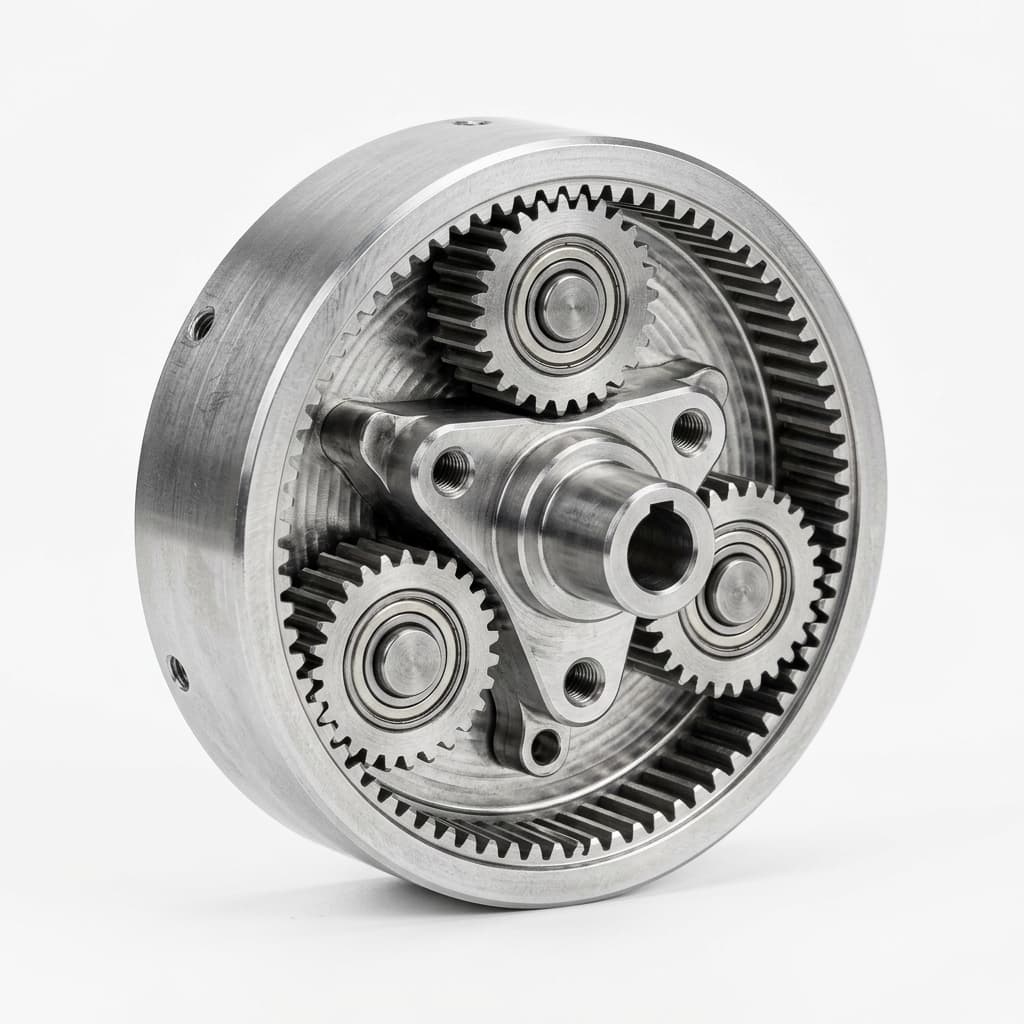
Planetary Roller Screw Housing CNC Integration Guide for Robotics NPI
How to define support-housing geometry and inspection controls around roller-screw actuators without over-claiming core screw production scope.
Robotics teams often secure a high-value roller screw first, then discover the schedule bottleneck has moved to housing integration. Most delays are caused by support-structure precision, not by screw availability alone.
Positioning bridge: roller screw housings belong to Linkup's robotics motion hardware route as support structures and CNC interface work around actuator assemblies. The page should qualify housing geometry, datum-chain control, and pilot evidence while keeping core screw production outside the default scope.
Related routes:
- Planetary Roller Screw Housing CNC
- Robotics & Automation Solution Route
- Prototype-to-Pilot Manufacturing
Scope boundary first
Keep project scope explicit:
- in scope: support housings, flanges, and integration-critical metal structures;
- out of scope unless agreed: roller-screw core manufacturing claims.
This boundary protects sourcing decisions from promise inflation and keeps qualification time short.
Integration failure map around housing stacks
| Zone | Typical failure mode | Program impact | Early control |
|---|---|---|---|
| Bearing seat chain | Coaxial drift between seats and motor-side interface | Noise, preload instability, efficiency loss | Datum chain lock before first sample |
| Flange reference plane | Flatness/parallelism drift | Misalignment during module assembly | Plane and bolt pattern inspection strategy |
| Coupling-side support features | Positional variation under torque path | Integration rework and delayed pilot pass | CTQ class split and measurement setup |
| Lightweighting pockets | Local stiffness drop and vibration sensitivity | Dynamic behavior inconsistency | Stiffness-aware geometry review |
Geometry priorities for first-article success
Robotics programs should prioritize:
- concentricity chain between bearing seats and mounting interfaces;
- tolerance strategy for preload-sensitive surfaces;
- lightweighting features that do not compromise inspection accessibility.
Coaxial chain governance model
A practical approach is to define the coaxial chain as a closed contract:
- Primary datum references the most integration-critical bearing seat.
- Secondary datum references mounting plane that controls module orientation.
- Tertiary datum references anti-rotation or locator feature.
- Every CTQ in the chain has one named measurement setup and one owner.
If one CTQ cannot be measured in a repeatable setup, route lock is premature.
Inspection-ready RFQ structure
RFQ should include:
- full datum reference strategy;
- tolerance class for actuator-critical zones;
- assembly interface notes and expected fit behavior;
- verification method and report format.
When these elements are missing, NPI loops usually become iterative and expensive.
Visual: housing integration flow for NPI
Pilot acceptance table
| Gate | Exit condition | Minimum evidence |
|---|---|---|
| G1 Scope lock | In-scope/out-of-scope line accepted | Scope note attached to RFQ |
| G2 Datum lock | Coaxial chain and CTQ methods frozen | Datum matrix + method sheet |
| G3 Pilot pass | CTQ and fit behavior pass in assembly trial | First-article report + integration notes |
| G4 Repeat support release | Sampling and NCR containment plan closed | Repeat-lot control plan |
Repeat-support controls
For repeat support, define:
- revision freeze point per pilot phase;
- lot-level traceability fields;
- non-conformance handling workflow;
- fast ECN response path.
This gives sourcing and engineering a shared operating model from prototype to repeat delivery.
Supplier comparison scorecard
When screening suppliers, compare execution quality with a simple weighted scorecard:
| Dimension | Weight | What to look for |
|---|---|---|
| Datum and CTQ clarity | 30% | Explicit chain and measurable CTQ definitions |
| Inspection reproducibility | 25% | Stable setup across pilot and repeat |
| Integration evidence quality | 25% | Assembly-trial feedback included, not just dimensions |
| Change response speed | 20% | ECN turnaround with documented impact notes |
This keeps decisions technical and repeatable across programs.
Reusable RFQ block
Program: [name]
Assembly node: [actuator axis]
Screw interface type: [reference]
Drawing revision: [rev]

Scope:
- In-scope housing and support structures:
- Out-of-scope statements:

Critical controls:
- Coaxial chain CTQs:
- Mounting plane/bolt pattern controls:
- Pilot acceptance evidence required:
The more explicit this block is, the fewer NPI loops you will spend on basic clarification.
Author

Categories
More Posts
Machined-from-Billet Titanium as a Casting Delay Mitigation Path
Decision guide for using billet-machined titanium as a bridge strategy when casting schedules threaten prototype and pilot milestones.
SMC Motor Core Route Boundaries for Robotics Programs
Boundary-first playbook for robotics teams evaluating soft magnetic composite core routes, including geometry-fit rules, interface controls, and pilot acceptance criteria.
PFAS-Free CNC Machining & Surface Finishes - 2026 Compliance Checklist
PFAS-free CNC machining checklist for auditing coolants, anodizing, cleaning, supplier records, and 2026 sourcing risk. Talk to Linkup Precision.