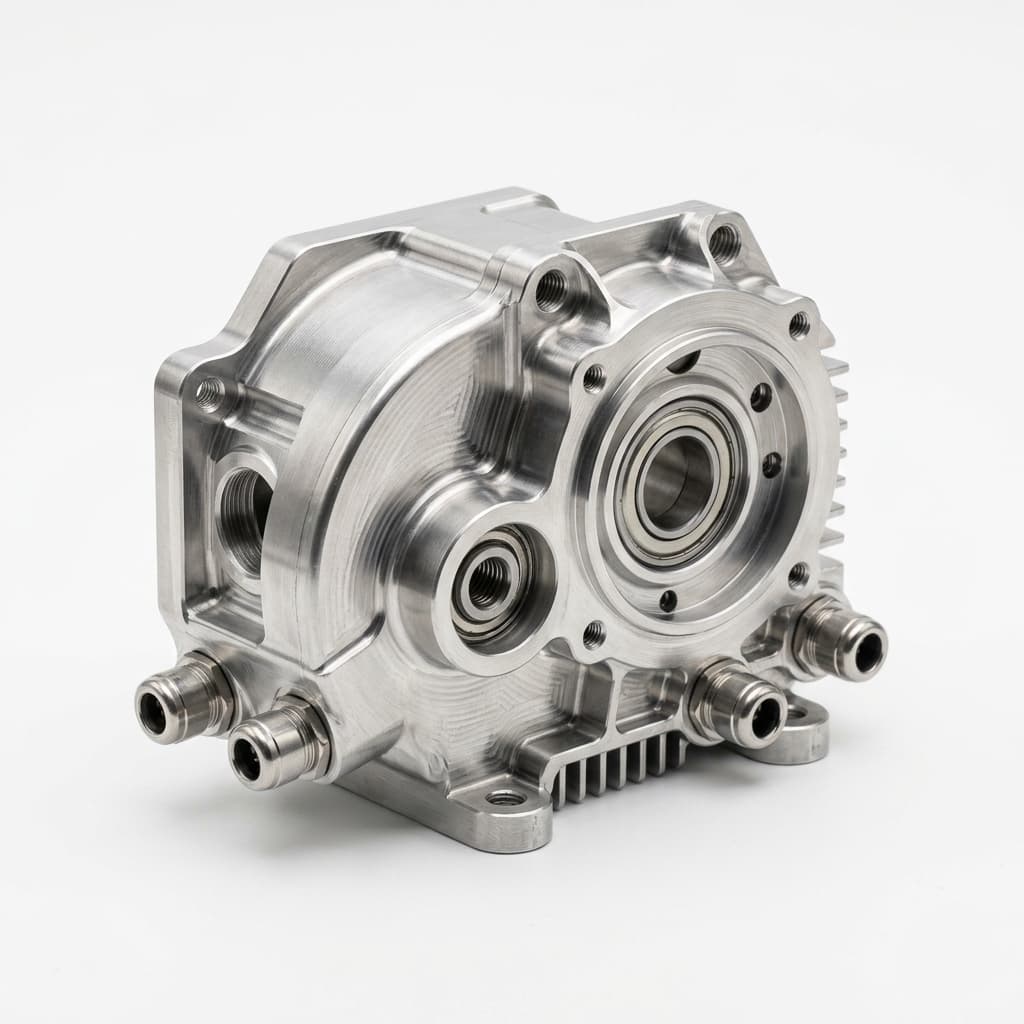
Humanoid Linear Actuator Enclosure DFM and Acceptance Workflow
Execution workflow for humanoid actuator enclosure machining with fit-critical interfaces, tolerance management, and validation checkpoints.
Humanoid actuator enclosure programs usually fail late for one reason: teams optimize geometry for mass and packaging, then try to add validation logic afterward.
Positioning bridge: linear actuator enclosures sit in Linkup's robotics motion hardware route as machined interface structures. The useful scope is DFM, datum control, enclosure inspection, and pilot evidence around the actuator node, not ownership of the motor, reducer, controls, or system-level performance stack.
Related routes:
- Humanoid Linear Actuator Enclosure CNC
- Robotics & Automation Solution Route
- Product Families by Thread Role
If you are running NPI with weekly ECOs, enclosure execution should be treated as one integrated loop:
- Function and load path definition.
- DFM route and tolerance budget.
- Measurement and acceptance contract.
- Pilot evidence and release decision.
Where schedule slip typically starts
Three patterns show up repeatedly:
- topology changes continue while datum strategy is already frozen;
- thin-wall and pocket geometry are pushed without measurement access review;
- first-article reports are accepted without a repeat-lot sampling rule.
When these patterns appear together, pilot lots pass once but repeat lots drift.
CTQ map that should exist before first sample
Use a CTQ table that links feature class to verification method and owner.
| Feature zone | Primary risk | Verification method | Pilot rule | Owner |
|---|---|---|---|---|
| Bearing-interface bores | Coaxiality drift and preload inconsistency | CMM + dedicated coaxial fixture check | 100% on pilot | Supplier QA + buyer mechanical lead |
| Mounting flange and datum plane | Assembly misalignment and force path skew | Flatness/parallelism scan + gauge | 100% on pilot | Supplier QA |
| Thin-wall weight-reduction pockets | Local deformation and chatter-induced variation | Wall-thickness scan + visual criteria | Statistical + escalation trigger | Process engineer |
| Fastener and locating features | Stack-up mismatch at integration | Positional tolerance CMM report | 100% on first article | QA + integration engineer |
If a row has no measurement method or no owner, the program is not RFQ-ready.
DFM sequence by phase
Treat enclosure DFM as a staged contract rather than a one-shot quote review.
| Phase | Objective | Required output | Stop condition |
|---|---|---|---|
| EVT route definition | Prove manufacturable geometry path | Toolpath constraints + fixture concept | Critical features still unmeasurable |
| DVT tolerance lock | Freeze CTQ budget by function | CTQ matrix + datum chain | ECO changes invalidate datum logic |
| PVT repeatability plan | Prepare repeat-lot stability | Sampling plan + reaction plan | No nonconformance containment rule |
| Pilot release | Align on ship/no-ship gate | Acceptance package and sign-off list | Evidence incomplete or owner unclear |
Visual: enclosure release workflow
Acceptance package requirements
A strong acceptance package should include:
- current revision release notes and ECO delta summary;
- CTQ matrix with method ID and responsible owner;
- first-article report with setup notes (not just values);
- repeat-lot sampling logic and reaction plan;
- open-risk register with closure date.
Pilot gate checklist
| Gate | Exit condition | Evidence |
|---|---|---|
| G1 Geometry freeze | No unresolved interface geometry questions | Released drawing set + revision tracker |
| G2 Inspection readiness | All CTQs measurable in planned setup | Method sheet + sample report template |
| G3 Process readiness | Repeat-lot stability plan accepted | Sampling rule + containment plan |
| G4 Release decision | Buyer and supplier sign-off complete | Pilot package + action list closed |
If one gate is red, ship decision should be blocked.
RFQ prompt block buyers can reuse
Program: [project name]
Actuator node: [joint/axis]
Drawing revision: [rev]
Pilot quantity: [x]

Critical interfaces:
- Bearing/mounting datums:
- Required coaxiality/runout:
- Fastener and locating tolerance:

Validation contract:
- Required first-article fields:
- Sampling rule for repeat lots:
- Nonconformance response SLA:
Communication cadence that actually works
Run one short weekly engineering-sourcing review with fixed agenda:
- open dimensional risks;
- drawing revision changes;
- first-article findings;
- next-lot mitigation actions.
This structure keeps enclosure programs stable even when product requirements evolve.
Scope boundary note
This article covers enclosure machining and validation governance. It does not claim actuator-system performance ownership across motor, reducer, and controls subsystems. Keep system-level acceptance boundaries explicit in each RFQ.
Author

Categories
More Posts
EU CBAM Data-Readiness for CNC Aluminum Components: A Procurement Checklist
Use this 2026 procurement checklist to source CNC aluminum components for EU CBAM readiness: emissions evidence, supplier questions, and RFQ controls.
PM MIM DFM Handoff - Prototype to Pilot Control Plan
Detailed handoff protocol for PM/MIM transition programs, including data package requirements, gate governance, and escalation rules for robotics hardware teams.
Digital Product Passport (DPP) Data Readiness for CNC Machined Assemblies
A 2026 procurement guide to CNC machining supplier DPP readiness under EU ESPR, with data vectors, RFQ audit checks, source limits, and buyer actions.