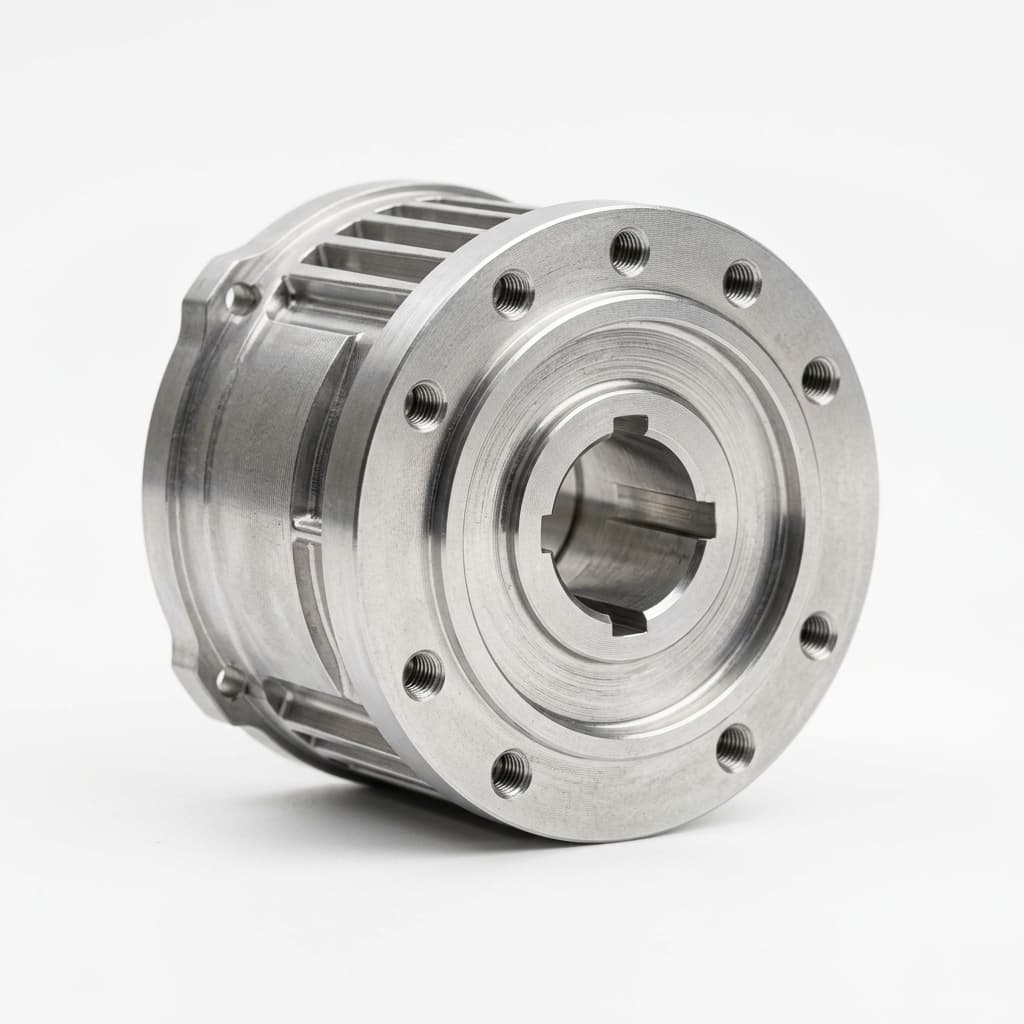
Machining Invar & Kovar for Silicon Photonics - A DFM & Cost Guide
Learn why optical transceivers for AI data centers require ultra-low CTE alloys, and how to optimize Invar 36 and Kovar CNC machining for procurement cost.
As of July 25, 2026, AI data center optical roadmaps are pushing 1.6T-class transceivers and 3.2T development programs. At these speeds, silicon photonics packaging faces a critical mechanical constraint: thermal expansion. When optical transceivers heat up under heavy compute loads, standard aluminum or stainless steel housings expand, throwing sub-micron laser alignments out of focus and causing catastrophic signal loss.
To solve this, hardware engineers specify ultra-low Coefficient of Thermal Expansion (CTE) alloys—primarily Invar 36 and Kovar.
For procurement teams and supply chain managers sourcing precision CNC machined components, these alloys represent a massive sourcing challenge. Kovar and Invar are notoriously difficult to machine. They are "gummy," work-harden rapidly, and destroy cutting tools at an alarming rate. When an engineer switches a housing material from Aluminum 6061 to Kovar, the quoted unit cost often jumps by 400% to 600%.
This guide provides a comprehensive framework for procurement professionals and hardware engineers to understand the cost drivers of machining low-CTE alloys, identify over-toleranced features, and leverage Design for Manufacturability (DFM) to reduce unit costs in optical packaging.
Scope and Limitations
This guide is intended for procurement teams and hardware engineers sourcing low- to mid-volume precision CNC machined Invar 36 and Kovar components for optical transceivers, LiDAR housings, and laser diode mounts. It focuses on subtractive manufacturing (CNC) limits. For high-volume production (100,000+ units), Metal Injection Molding (MIM) is often a more viable economic path, though it requires significant upfront tooling investment.
Last reviewed: July 25, 2026. The CTE and cost ranges below are RFQ-screening assumptions, not purchase specifications. Final alloy choice should be confirmed against the material certificate, heat-treatment condition, sealing stack, drawing tolerances, and the supplier's process capability.
RFQ Decision Snapshot
Use this quick screen before releasing an Invar or Kovar RFQ:
- Use Invar 36 when dimensional stability is the main risk and the assembly does not need glass-to-metal or ceramic-to-metal sealing.
- Use Kovar when the housing or feedthrough must match glass, alumina, or ceramic expansion behavior in a hermetic optical package.
- Keep Aluminum 6061 only when the optical alignment budget can absorb thermal movement or when active compensation is already designed into the module.
- Evaluate MIM before CNC when annual demand moves beyond roughly 50,000 pieces and the geometry is stable enough to justify tooling.
- Ask suppliers to quote tolerance tiers separately: optical datum faces, sealing faces, non-critical outside profiles, and cosmetic surfaces should not carry the same tolerance or finish requirement.
Why Invar 36 and Kovar Are Mandatory for Photonics
The fundamental reason these alloys are used is their near-zero thermal expansion at operational temperatures (typically 20°C to 100°C for data center optics).
- Invar 36 (FeNi36): Has a CTE of roughly 1.2 µm/m·°C. It is the gold standard for dimensional stability in pure mechanical alignment applications.
- Kovar (FeNiCo): Has a CTE of roughly 5.0 µm/m·°C, which perfectly matches the thermal expansion rate of borosilicate glass and alumina ceramics. It is essential when creating hermetic glass-to-metal or ceramic-to-metal seals in laser packaging.
For comparison, Aluminum 6061 has a CTE of ~23.6 µm/m·°C. In a 50mm optical housing experiencing a 50°C temperature swing, aluminum will expand by nearly 60 microns—enough to completely misalign a single-mode fiber optic array.
Thermal Expansion vs. Machinability
As CTE decreases (better optical stability), machinability drops drastically, driving up cycle times and tooling costs.
Why Kovar and Invar Are So Expensive to Machine
When reviewing a quote for an Invar optical housing, procurement teams must understand that the high price is not simply a markup on raw material. The primary cost drivers occur inside the CNC machine.
- Work Hardening: Both Invar and Kovar are high-nickel alloys. If a cutting tool rubs against the material instead of slicing cleanly, the surface immediately hardens. A hardened surface will shatter the next cutting tool that attempts to pass over it.
- "Gummy" Chip Formation: Unlike aluminum which chips cleanly, low-CTE alloys are ductile and "gummy." The material tends to weld itself to the cutting edge (Built-Up Edge, or BUE). This requires high-pressure, through-tool coolant and very specific, slow feed rates to flush chips away.
- Tool Wear: The abrasive nature of the nickel and cobalt in these alloys means that solid carbide end mills dull rapidly. A tool that might last 20 hours cutting aluminum might only last 45 minutes cutting Kovar. The supplier must factor the cost of frequent tool replacements into the piece price.
Cost Driver Matrix: Aluminum vs. Kovar
To illustrate the cost impact, compare a standard 50mm x 50mm optical transceiver baseplate machined in Aluminum 6061 versus Kovar.
| Production Variable | Aluminum 6061 | Kovar (FeNiCo) | Cost Impact | Procurement Insight |
|---|---|---|---|---|
| Raw Material Cost | ~$5 / kg | ~$80 - $120 / kg | High | Raw material is a significant baseline cost, but scrap becomes highly punitive. |
| Machinability Rating | 100% | 20% - 25% | Very High | Machine cycle time will be 4x to 5x longer, directly increasing hourly machine rates. |
| Tool Life (End Mills) | ~20 hours | ~45 minutes | High | Expect heavy tooling surcharges on quotes. Suppliers cannot absorb this consumable cost. |
| Coolant Requirement | Standard flood | High-pressure through-spindle | Medium | Requires advanced 5-axis machines with high-pressure pumps; you cannot source this to low-end job shops. |
| Stress Relief (Annealing) | Optional | Mandatory | Medium | Kovar must be annealed in a hydrogen or vacuum atmosphere to remove machining stresses before glass sealing. |
| Surface Finish Limits | Ra 0.4 µm (Easy) | Ra 0.8 µm (Standard) | Low | Achieving Ra 0.4 µm in Kovar requires extreme care and fresh tooling. Only specify on critical sealing faces. |
The DFM Checklist for Low-CTE Alloys
Procurement teams should work with engineering to review drawings against this checklist before sending RFQs for Invar or Kovar components.
- 1. Eliminate Deep Pockets: Because tool wear is so high, deep pockets (depth > 3x diameter) are incredibly slow to clear out. If possible, design the housing as a two-piece bolted assembly rather than a deep monolithic tub.
- 2. Maximize Internal Radii: Do not use sharp internal corners. Ensure internal radii are at least 1.5x the depth of the pocket to allow the machinist to use a larger, more rigid end mill.
- 3. Avoid Extremely Thin Walls: While Kovar is strong, thin walls (less than 1 mm) can vibrate (chatter) during machining. Given the gummy nature of the metal, chatter leads to rapid tool failure and poor surface finishes.
- 4. Specify Annealing Requirements Clearly: If the part will undergo glass-to-metal sealing later, specify the exact pre-oxidation or annealing standard required (e.g., AMS-I-23011 for Invar). This prevents post-machining supply chain delays.
- 5. Restrict Tight Tolerances (±0.01mm) to Mating Faces Only: Do not apply blanket ±0.01mm tolerances. Only apply tight GD&T callouts to the laser diode mounting pads and fiber array interfaces. Loosen outer perimeters to ±0.1mm.
Frequently Asked Questions (FAQ)
Q: Can we use standard Stainless Steel 304 instead of Kovar to save money?
A: Only if your thermal operating window is extremely narrow and you do not require glass-to-metal hermetic sealing. SS304 has a CTE of ~17 µm/m·°C, which will easily misalign a 1.6T silicon photonics array during standard data center temperature fluctuations.
Q: Why does the supplier require a minimum order quantity (MOQ) for the Kovar raw material?
A: Unlike aluminum, which is stocked in every local metal supply warehouse, Kovar and Invar are specialty aerospace/electronics alloys. Suppliers often have to buy mill runs or full sheets, meaning they will pass the minimum material buy cost onto your first prototype order.
Q: If we need 50,000 units per year, should we still CNC machine Kovar?
A: At 50,000 units, you should strongly evaluate Metal Injection Molding (MIM). While the MIM mold might cost $15,000 to $30,000, the unit price for a MIM Kovar part will be a fraction of the CNC machined cost. CNC is best for prototypes, low-volume (1-5000), and geometries too large or complex for MIM.
Sources & References
- Optica industry programs: Market context for optics and photonics supply-chain priorities.
https://www.optica.org/industry/ - Society of Manufacturing Engineers (SME): General manufacturing guidance for difficult-to-machine alloys, process control, and tooling trade-offs.
https://www.sme.org/ - Machining Alloy 52 Kovar using different machining environments: Peer-reviewed machining study for Kovar-class alloy behavior under different cooling/lubrication approaches.
https://doi.org/10.1016/j.procir.2018.09.047 - Machinery's Handbook, 32nd Edition (Industrial Press): Shop-floor reference for material properties, machinability, speed/feed baselines, and tolerance conventions.
https://books.industrialpress.com/machinery-handbook/
Next Steps for Procurement
Procurement teams scaling up optical transceivers or LiDAR systems must proactively manage the transition to low-CTE alloys. Sending a native Kovar design to a supplier without first optimizing it for machinability will result in bloated budgets and delayed NPI launches.
At Linkup Precision, our engineering team specializes in the machining constraints of Invar, Kovar, and Titanium. We routinely perform DFM audits on optical housings to identify cost-saving opportunities before the first chip is cut.
Contact our engineering team today for a comprehensive DFM review and quote on your next photonics packaging project.
Author

Categories
More Posts
Generative Design & AI Parts: CNC Machinability and Cost Guide for Buyers
Evaluate generative design AI parts for CNC machinability, cost drivers, QA risk, hybrid routing, and DFM push-back before RFQ with supplier-ready checks.
Humanoid Linear Actuator Enclosure DFM and Acceptance Workflow
Execution workflow for humanoid actuator enclosure machining with fit-critical interfaces, tolerance management, and validation checkpoints.
PM MIM DFM Handoff - Prototype to Pilot Control Plan
Detailed handoff protocol for PM/MIM transition programs, including data package requirements, gate governance, and escalation rules for robotics hardware teams.