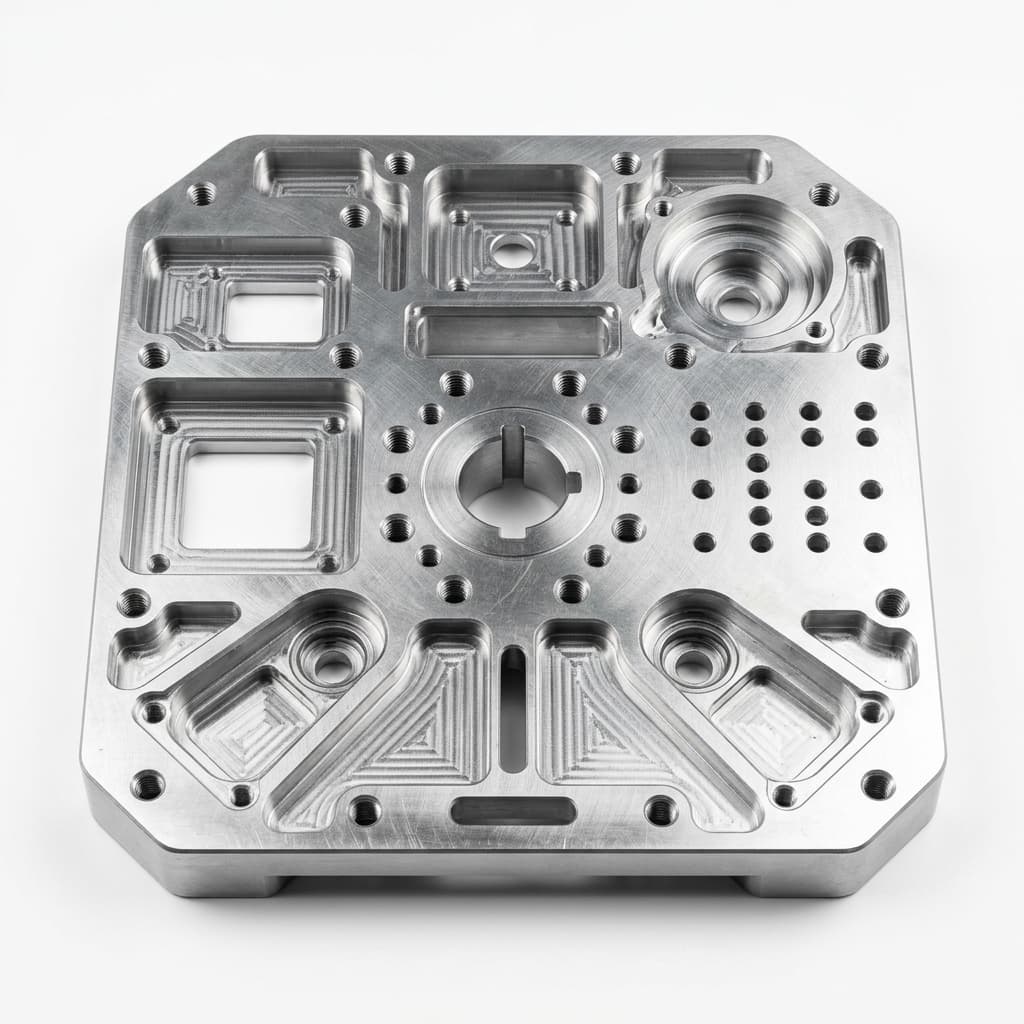
Megawatt CDU Manifold Machining: NPI Constraints and DFM Controls
A guide to machining and validating megawatt-class CDU manifolds with deep-port geometry, sealing interfaces, and staged approval gates.
Megawatt-class CDU hardware introduces scale effects that many teams only see at integration stage: distortion sensitivity, port-interface variability, and inspection bottlenecks.
See solution page: Megawatt CDU Manifold Machining.
Why megawatt manifolds fail differently
At this scale, small geometric drift creates large system impact because one block serves many flow branches. Problems are usually systemic:
- fixture and process sequence create cumulative port-reference drift;
- deep channel and cross-port geometry complicate repeatable inspection setup;
- sealing-face quality is evaluated too late, after expensive cycle time is already consumed.
Why this category behaves differently
Compared with smaller fluid blocks, megawatt manifolds add:
- larger mass with tighter port-alignment expectations;
- higher coupling between machining sequence and sealing behavior;
- broader tolerance stack across multiple interfaces.
That means process planning must be done as a system, not as isolated feature machining.
CTQ family table for CDU manifold programs
| CTQ family | Typical risk | Minimum control |
|---|---|---|
| Port position chain | Misalignment at mating interfaces | Datum strategy across inlet/outlet families |
| Sealing-face geometry | Leak-risk escalation at assembly | Flatness + finish criteria with measurable setup |
| Thread and interface form | Installation inconsistency | Thread class verification and gauge plan |
| Flow-path transitions | Pressure drop and non-uniform branch behavior | Geometry consistency checkpoints by channel class |
DFM controls to define early
For better first-pass outcomes, set these controls before sampling:
- datum strategy across all critical ports;
- staging of roughing, finishing, and inspection checkpoints;
- interface-specific criteria for flatness and surface quality;
- test plan that reflects actual assembly constraints.
Visual: manifold NPI control loop
Pilot gating model
A practical pilot model uses three gates:
- Gate A - geometry readiness: drawing clarity, fixture plan, datum coverage.
- Gate B - manufacturing readiness: in-process measurement capability.
- Gate C - validation readiness: leak-oriented and dimensional acceptance package.
Programs that skip Gate B usually pay with longer iteration loops and unstable lead-time forecasts.
Gate criteria detail
| Gate | Exit condition | Required evidence |
|---|---|---|
| Gate A - Geometry readiness | Drawings and datum references are unambiguous | Released revision pack + CTQ table |
| Gate B - Manufacturing readiness | Process sequence and fixture strategy can hold CTQs | In-process checkpoint sheet |
| Gate C - Validation readiness | Leak-risk and dimension acceptance criteria are frozen | Pilot report template + test method |
Leak validation boundary discipline
For CDU programs, avoid absolute leak claims. Use bounded statements tied to test conditions:
- test method (for example helium or pressure-hold) must be named;
- pressure differential and hold time must be defined by RFQ;
- pass/fail threshold must be recorded in pilot acceptance documents.
This keeps performance claims auditable and reduces dispute risk at release stage.
Procurement-side comparison template
When comparing suppliers, ask for:
- process sequence summary;
- inspection coverage list by feature group;
- first-article report structure;
- batch repeatability assumptions;
- revision-change response window.
This keeps selection criteria technical and schedule-relevant, rather than price-only.
Practical supplier scorecard
| Dimension | Weight | Target signal |
|---|---|---|
| CTQ coverage quality | 30% | Complete CTQ list with method mapping |
| Fixture/sequence maturity | 25% | Stable in-process checkpoints |
| Validation transparency | 25% | Clear leak and dimensional acceptance format |
| Change response speed | 20% | Defined ECO turnaround and impact note |
RFQ block for engineering and sourcing alignment
Program: [name]
Manifold revision: [rev]
Port/interface standards: [spec]
Pilot quantity: [x]

Leak and validation:
- Test method:
- Pressure and hold-time:
- Pass/fail threshold:

Documentation:
- First-article report fields:
- Repeat-lot sampling plan:
- ECO response window:
Teams that lock this block early usually shorten NPI loops and reduce rework.
Author

Categories
More Posts
EU CBAM Data-Readiness for CNC Aluminum Components: A Procurement Checklist
Use this 2026 procurement checklist to source CNC aluminum components for EU CBAM readiness: emissions evidence, supplier questions, and RFQ controls.
Machined-from-Billet Titanium as a Casting Delay Mitigation Path
Decision guide for using billet-machined titanium as a bridge strategy when casting schedules threaten prototype and pilot milestones.
Stress Relief for CNC Aluminum Parts: Why Micron-Level Tolerances Fail After 48 Hours
Practical stress relief process guide for 2017 aluminum CNC parts covering residual stress sources, furnace parameters, soak times, and cooling methods to prevent post-machining deformation in precision programs.